
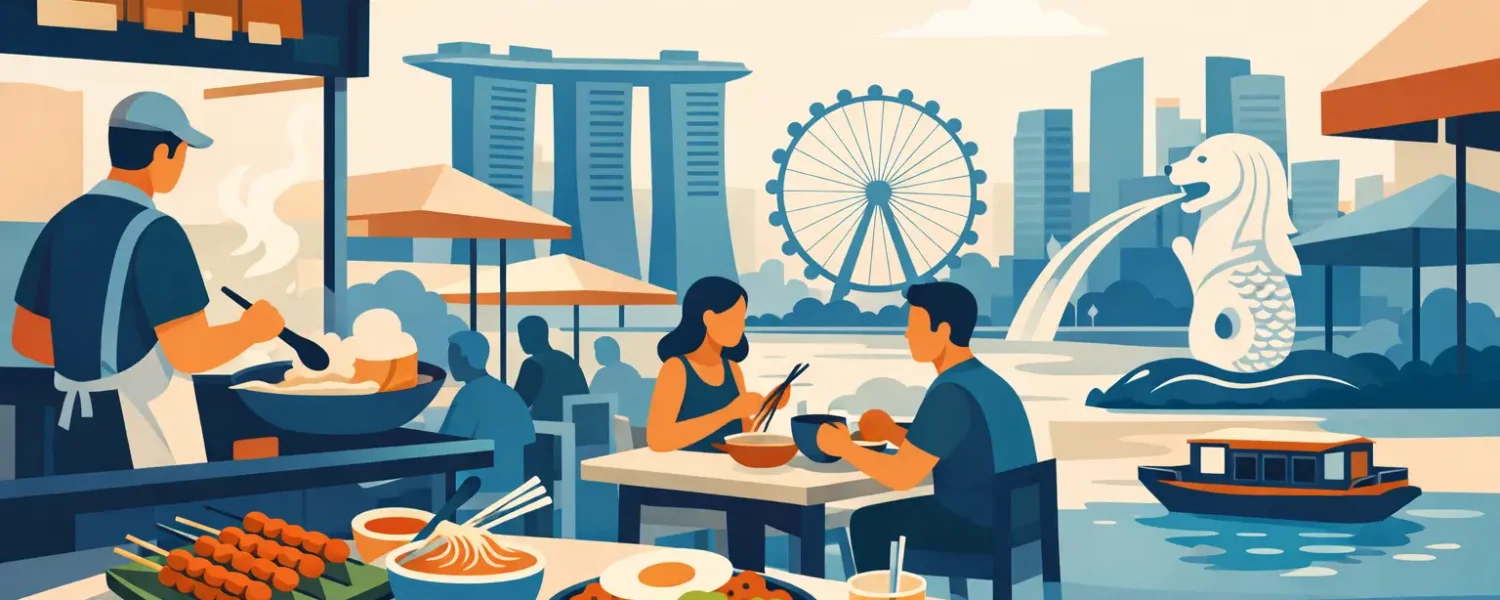
At a hawker center, you can hear Singapore before you fully understand it. A coffee order called across the aisle, satay smoke curling into the air, the clatter of trays, the quick scan for an empty table – all of it tells you something real about the country. If you want to understand how hawker food shaped Singapore, start there, where everyday life is loud, fragrant, and shared.
This is not just a story about what people eat. It is a story about how a young nation learned to live together, remember where it came from, and turn ordinary meals into something deeply local.
How hawker food shaped Singapore’s identity
Singapore is often described through efficiency, skyline views, and global business appeal. Those things are true, but they are not the whole picture. Hawker food gives the country its emotional texture. It is where migration histories become dinner, where family habits survive modern life, and where different communities meet without ceremony.
The dishes themselves carry the fingerprints of movement. Chinese, Malay, Indian, Peranakan, and other influences did not stay in separate boxes. They met in kitchens, adapted to local ingredients, shifted with neighborhood tastes, and evolved through generations of vendors trying to feed working people well and affordably. That mix created something distinctly Singaporean.
Chicken rice is a good example. Its roots stretch beyond the island, yet the local version became part of national shorthand. The same goes for laksa, nasi lemak, roti prata, satay, and cendol. None of these dishes exist in a vacuum. In Singapore, they became part of a common language. Ask a local where to get a good plate, and you are not just asking for directions. You are entering a conversation about memory, standards, neighborhood pride, and personal taste.
That matters because national identity is rarely built only through official symbols. It is built through repeated rituals that people actually enjoy. Hawker food became one of those rituals.
From street trade to social glue
Long before hawker centers became beloved institutions, many food sellers worked on the streets. They served laborers, dock workers, families, and passersby who needed quick, affordable meals. The food was practical, but the social role was bigger than that. Hawkers made cities livable. They fed a fast-growing population and created informal gathering points in daily life.
As Singapore urbanized, the government moved street hawkers into regulated centers. This shift improved sanitation and public order, but it also changed the shape of communal eating. What might have been lost in spontaneity was replaced by something else – a durable, accessible public space where people from different backgrounds could still eat side by side.
That side-by-side quality is one of the most important ways hawker food shaped Singapore. In many cities, class lines show up clearly in dining habits. In Singapore, hawker centers have long softened that divide. Office workers, retirees, tourists, students, and taxi drivers can all end up at neighboring tables, eating different dishes from different stalls under the same roof.
It would be too neat to say food erased social differences. It did not. But it created a daily setting where people shared space, routines, and references. That is no small thing in a multicultural society.
A table for many cultures
Singapore often speaks proudly about multiculturalism, and hawker food makes that idea tangible. It is one thing to celebrate diversity in speeches. It is another to see a family order Malay grilled meats, Indian flatbread, Chinese noodle soup, and an icy dessert from another stall, then eat it all together.
At a hawker center, culture is not abstract. It arrives on trays. You taste spice blends shaped by migration, cooking methods inherited across generations, and dishes altered by local preferences. This is why hawker heritage feels so alive. It is not preserved behind glass. It is still being cooked, argued over, and improved one plate at a time.
Why iconic dishes matter more than they seem
People sometimes talk about hawker food as if it is simple comfort food. That is true, but only partly. These dishes carry history in a very efficient form.
Satay tells a story of regional trade, spice, fire, and sociability. Laksa reflects layers of cultural exchange, with every bowl showing a balance of richness, heat, and local character. Nasi lemak brings together fragrance, texture, and tradition in a meal that feels both humble and complete. Prata speaks to adaptation and skill, while cendol reminds you that dessert in this climate is not a side note – it is relief, pleasure, and memory.
What makes these foods powerful is repetition. People do not encounter them once on a heritage trail and move on. They eat them after school, during lunch breaks, on weekends with relatives, late at night with friends. The dishes become woven into life stages. That is how food turns into identity.
For visitors, this can be easy to miss at first. A plate of chicken rice may look straightforward. But to locals, it can be a marker of standards, nostalgia, and belonging. Which stall gets the rice right? Is the chili balanced? Is the poached chicken silky enough? These are not minor details. They are part of a culture that takes everyday food seriously because everyday food has helped define the place.
Hawker centers as memory banks
Cities change quickly, and Singapore knows that better than most. Neighborhoods redevelop, family businesses close, and new trends arrive fast. Hawker centers have helped anchor continuity in the middle of that change.
A stall recipe passed from parent to child is not just a business asset. It is a living archive. The same goes for cooking techniques that rely on touch, instinct, and years of repetition. Even the names of certain dishes can carry old speech patterns and community references. When people queue for a familiar bowl or bring guests to a trusted stall, they are participating in cultural memory.
This is one reason hawker culture resonates with both locals and travelers. For locals, it can feel like a return to something grounding. For visitors, it offers a way into Singapore that feels more intimate than sightseeing alone. You do not just observe the culture. You taste how it remembers itself.
There is a trade-off, of course. As younger generations consider different careers and rents rise, some traditional stalls face real pressure. Heritage cannot survive on nostalgia alone. It needs people who value the craft enough to support it, learn it, and keep showing up hungry.
How hawker food shaped Singapore’s global image
Singapore’s food reputation travels far beyond the island, and hawker culture is a big reason why. It gives the country a point of distinction that feels democratic and deeply human. Fine dining may impress, but hawker food tells a more persuasive story: here is a place where extraordinary flavor is part of ordinary life.
That story has become one of Singapore’s most welcoming introductions. Travelers may arrive for famous landmarks or business events, but many leave talking about the satay they ate at a busy table or the laksa they are still thinking about on the flight home. Hawker food makes the city feel less distant and more personal.
It also changes the way people understand local heritage. Food is often the fastest bridge across cultures because it is sensory, social, and immediate. You do not need prior knowledge to appreciate crisp prata or fragrant coconut rice. Once the dish draws you in, the deeper story can follow. That is why guided food experiences work so well for culturally curious travelers and teams looking for something more memorable than a standard meal. Done well, they turn lunch into a lens on migration, identity, and community.
At J.I.A.K 99, that is the joy of the experience – helping people taste the stories behind the dishes, not just the dishes themselves.
A living culture, not a frozen one
One of the best things about hawker culture is that it is still evolving. New vendors experiment. Old recipes get small updates. Diners debate what should stay traditional and what can change. That tension is healthy. Heritage that never moves can become performance. Heritage that adapts carefully can stay relevant.
The key is knowing what should be protected and what can be playful. A classic dish can welcome variation without losing its soul. A hawker center can modernize while keeping its communal spirit. Singapore has always been shaped by movement, exchange, and reinvention. Its food reflects that truth beautifully.
So if you are wondering how hawker food shaped Singapore, the answer is bigger than flavor, though flavor is a very good place to start. Hawker food taught the nation how to gather, how to blend influences without flattening them, and how to keep history close to everyday life. Come hungry, pay attention, and let the next shared table tell you the rest.