
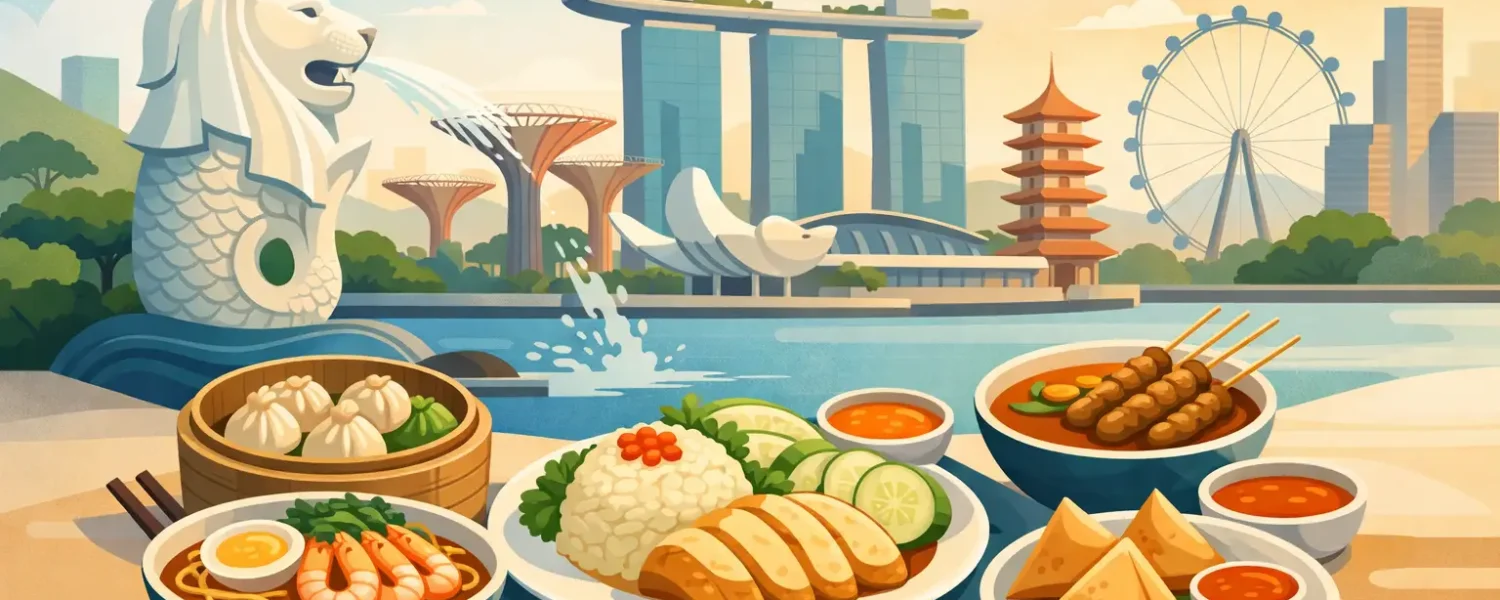
Stand in front of a hawker stall at lunch and you can watch singapore immigrant food history happen in real time. A bowl of laksa, a plate of chicken rice, a round of satay, a cold cendol – none of these dishes arrived as fixed, finished ideas. They were carried, adapted, argued over, sweetened, spiced, and made local by generations of migrants who turned survival into flavor.
That is what makes Singapore’s food story so shiok. Hawker food is not just a greatest-hits lineup of tasty dishes. It is the record of movement – people crossing seas from southern China, the Malay Archipelago, India, and beyond, then building communities in crowded port neighborhoods, kampungs, markets, and street stalls. Every recipe tells you who came, what they missed, what ingredients they could find, and how they learned to cook beside someone from somewhere else.
Why singapore immigrant food history matters at the table
If you only look at hawker food as a checklist, you miss the best part. The magic is not just that Singapore has many cuisines. It is that the cuisines kept meeting one another.
A port city changes food fast. Traders, laborers, sailors, clerks, and families do not eat in neat cultural boxes forever. They borrow. They substitute. They sell to neighbors with different tastes. A dish that began in one community might be adjusted for another, and then adjusted again until it becomes unmistakably Singaporean.
That is why local food can feel both familiar and surprising. Chicken rice has roots in Hainanese cooking, yet the version many people know here is shaped by local climate, local diners, and the efficiency of the hawker trade. Prata comes from South Asian flatbread traditions, but the prata culture many visitors know today is built around late-night suppers, curry pairings, and distinctly local eating habits. The history is never just origin. It is origin plus adaptation.
A port city built by movement
Before there was a modern nation-state, there was a trading world. The island sat in a region where goods, people, and cooking ideas traveled constantly. When colonial trade expanded in the 19th century, migration intensified. Chinese laborers, Indian traders and workers, Malay communities, Arab merchants, and others all contributed to a fast-changing food landscape.
Many migrants arrived with little, but food skills traveled well. Selling cooked food required less capital than opening a formal establishment. Street vending became a practical livelihood, especially for newcomers trying to support families. That is one reason hawker culture matters so much in immigrant history – it was economic history too.
Food stalls also became social anchors. People looked for the tastes of home, but they also needed affordable meals in a new place. So the street and market became classrooms of taste. A newcomer might first cook for their own community, then start adjusting recipes for a wider crowd. Over time, those adjustments stopped feeling like compromises. They became tradition.
Chinese migration and the making of local favorites
Chinese communities shaped a huge part of Singapore’s everyday food culture, but even that phrase hides variety. Hokkien, Teochew, Cantonese, Hainanese, and Hakka migrants did not all cook the same way.
Take Hokkien mee. Its name points to Fujian roots, but the version associated with Singapore reflects local conditions, especially access to seafood and the influence of stall cooking. The dish became richer, smokier, and more tied to hawker life than to any single homeland template.
Hainanese chicken rice tells a similar story. Its lineage is often traced to Wenchang chicken from Hainan, yet the local dish evolved through adaptation. The poached chicken, fragrant rice, chili sauce, and dark soy pairing became part of a complete eating ritual shaped by local expectations. It is simple food, yes, but never plain. Technique matters, and so does the memory of migration behind it.
Then there is bak kut teh, with its different regional styles and ongoing debates. Peppery or herbal? Teochew-leaning or Hokkien-leaning? Those differences are the point. Immigrant food history is rarely tidy. It comes with sub-groups, rival preferences, and proud claims about what counts as the real version.
Malay and Indonesian roots in the national palate
Many dishes people now treat as essential Singapore eats have deep Malay and broader Nusantara roots. Nasi lemak, satay, and cendol are not side notes in the story. They are central to it.
Nasi lemak began as a fragrant, coconut-rich meal with deep ties to Malay cooking traditions. In Singapore, it expanded into many forms, from humble breakfast packets to loaded plates with fried chicken, sambal, egg, ikan bilis, and more. The core remains comfort and balance, but the expression changes from stall to stall.
Satay carries the story of grilling traditions, spice marinades, and communal eating. Its spread through the region shows how difficult it can be to draw hard national lines around food. That is not a weakness in the story. It is the story. Borders are newer than many recipes.
Cendol, with its shaved ice, coconut milk, gula melaka, and green jelly strands, speaks to climate as much as heritage. Migrant food survives not only through memory, but through weather, appetite, and available ingredients. Cold desserts thrive where heat is part of daily life.
Indian Muslim and South Asian influence on hawker culture
If you have ever torn into crispy prata with curry, you have tasted another major chapter of singapore immigrant food history. South Asian communities, including Indian Muslim traders and workers, left a lasting mark on local eating habits.
Roti prata reflects migration, adaptation, and performance. There is theater in the flipping of the dough, but the appeal runs deeper than spectacle. It is affordable, filling, and flexible. People eat it plain, with egg, with onion, with sugar, with fish curry, with mutton curry. Few dishes show local customization so clearly.
Briyani, murtabak, teh tarik, and various curry traditions also became part of the shared food landscape. Some remained closely tied to specific communities. Others crossed over completely into mainstream cravings. That crossover matters. When a dish becomes beloved outside its original group, it tells you something about how daily life has mixed people together.
Peranakan food and the art of blending
One of the clearest expressions of migrant mixing is Peranakan cuisine. Born from communities shaped by Chinese and Malay intermarriage and exchange, this food tradition shows that heritage can be layered rather than separate.
Laksa is a perfect example. There is no single laksa story that covers every bowl. But in Singapore, the dish captures fusion in a way people can literally taste – noodles, coconut milk, spice paste, seafood, herbs, all balanced in a format that reflects multiple culinary lineages. Rich, aromatic, and proudly local, it is the kind of dish that makes history feel immediate.
Peranakan cooking also reminds us that assimilation is not the same as erasure. New identities formed without fully abandoning older ones. Food became the place where those identities could be negotiated and celebrated at the same time.
Hawkers turned immigrant memory into everyday culture
The hawker is one of the most important figures in this story. Not because hawkers invented every dish from scratch, but because they preserved, refined, and circulated them.
Street vendors once faced tough conditions – irregular work, sanitation issues, and constant movement. Over time, regulation and the development of hawker centers changed that environment. The shift improved public health and gave many food businesses a more stable home, but it also altered the atmosphere. Some spontaneity was lost. Much was gained in continuity.
Today, a hawker stall can be a family archive. A recipe might pass from grandparent to parent to child, carrying techniques that never made it into formal records. A sambal recipe, a broth method, the exact timing for frying – these details are history too. Not museum history. Living history.
That is why curated food experiences matter. When someone explains the migration behind a dish, the meal becomes bigger than the plate. Brands like J.I.A.K 99 understand this well: people do not just want to eat local food, they want to know why it tastes the way it does and who made it possible.
What this history gets wrong when told too neatly
There is pride in celebrating multicultural food, but there is also a temptation to make the story too tidy. Not every exchange was harmonious. Migration often involved hardship, class inequality, colonial pressure, and difficult labor conditions. Food businesses were built through long hours and uncertain livelihoods.
There is also the question of ownership. Many iconic dishes are shared across the region, and debates over who owns what can get heated. Fair enough. Food carries identity. But for Singapore, the more useful lens is often contribution rather than possession. The local version of a dish matters because of how it was lived here, not because it emerged in isolation.
That nuance makes the food culture stronger, not weaker. A shared regional dish can still have a deeply specific local meaning.
Taste the story, not just the dish
The next time you sit down for chicken rice, prata, laksa, satay, nasi lemak, or cendol, pause before the first bite. Ask what journey is sitting in front of you. Which community carried it? What changed when it arrived? What stayed stubbornly the same?
That is where the real pleasure begins. You are not just eating something delicious. You are tasting memory, movement, and the everyday creativity that built a food culture people are still proud to call their own. Come jiak with curiosity, and the whole city starts talking.