
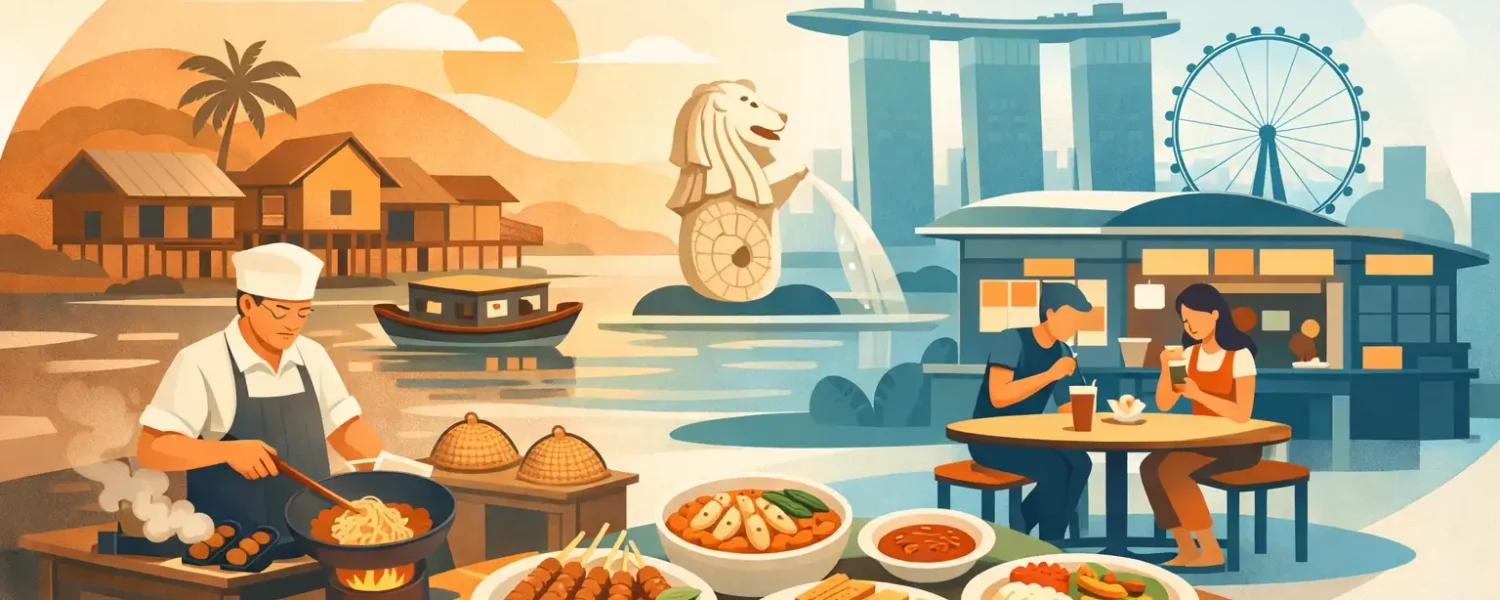
At a busy hawker center, you can hear it before you decide what to eat – the hiss of wok hei, the snip of scissors over noodles, the clatter of trays, the chorus of aunties and uncles calling orders. That everyday soundtrack is the history of Singapore hawker food in motion. It is not a museum piece. It is living heritage, shaped by migration, hard work, adaptation, and the very local habit of bonding over a really good meal.
For many visitors, hawker food feels instantly iconic. Chicken rice, laksa, satay, roti prata, nasi lemak, and cendol arrive as bold flavors on humble plates. But hawker culture did not appear fully formed. It grew out of crowded streets, working-class survival, and communities carrying recipes across oceans. To understand why hawker food matters so much, you have to start with the people who sold it long before hawker centers existed.
The history of Singapore hawker food begins on the street
In the 19th and early 20th centuries, street hawkers were part of daily life. Many were migrants or the children of migrants, trying to earn a living in a growing port city. They sold food because it required relatively little capital compared with opening a restaurant. A pushcart, a shoulder pole, a charcoal stove, or a small roadside setup could be enough to get started.
These early hawkers fed workers, dock laborers, rickshaw pullers, office clerks, and families who either had no time to cook or limited space and resources at home. Cheap, filling meals mattered. So did convenience. Street food was not a trendy concept. It was practical, accessible, and tied to the pace of urban life.
The dishes reflected where people came from. Chinese migrants brought regional food traditions from Hokkien, Teochew, Cantonese, and Hainanese communities. Malay cooks contributed spice blends, coconut-rich gravies, grilled meats, and rice dishes. Indian migrants brought flatbreads, curries, and techniques that reshaped local eating habits. Over time, Peranakan influence added another layer, blending Chinese and Malay ingredients and methods into something distinctively local.
That mix is one of the great reasons hawker food feels so unmistakably Singaporean. It is multicultural, but not in a neat textbook way. It is messy, practical, and delicious. Recipes changed according to what ingredients were available, what customers wanted, and what neighboring communities were eating.
Migration turned separate food traditions into shared favorites
A dish does not become national comfort food overnight. It usually starts smaller – inside a community, a dialect group, a family business, or a roadside stall serving people from the same neighborhood. Then it spreads.
Take Hainanese chicken rice. Its roots are tied to migrants from Hainan, but the version beloved today was shaped locally, with adaptations in rice cooking, chili sauce, and serving style. Laksa has many regional cousins, yet the bowls served in Singapore developed their own identity through local taste and hawker innovation. Satay traveled through Malay and Indonesian culinary pathways, then became a beloved part of the local night-food scene. Roti prata reflects Indian Muslim culinary heritage, but its place in Singapore life is now much broader than any single community.
That is the real charm of hawker food. It belongs somewhere specific, but it also belongs to everyone who queues for it, craves it, and argues about who makes it best. Food became one of the easiest ways for communities to meet each other. Not always formally, not always consciously, but bite by bite.
From roadside stalls to regulated hawker centers
As the city grew, street hawking brought real problems alongside its value. Congestion, poor sanitation, overcrowding, and unsafe food handling became serious public concerns. Hawkers were essential, but the street system was difficult to regulate. By the mid-20th century, authorities began pushing for a more organized solution.
This is one of the key turning points in the history of Singapore hawker food. Hawkers did not simply vanish. They were gradually resettled into purpose-built food centers, especially from the 1960s through the 1980s. These hawker centers offered water supply, waste disposal, seating, and better hygiene standards. For the public, it meant safer and more comfortable eating. For hawkers, it meant legal structure and more stable operating conditions.
Still, the shift came with trade-offs. Something was gained, and something changed. The move indoors improved sanitation and order, but it also altered the rough-and-ready character of street vending. Some of the spontaneity of roadside food culture faded. On the other hand, hawker centers helped preserve the trade itself by giving it a sustainable future in a fast-modernizing city.
That balance between preservation and adaptation is part of what makes hawker culture so fascinating. It survives not by staying frozen, but by changing without losing its soul.
Why hawker centers became more than places to eat
Once hawker centers took root, they became social spaces as much as food spaces. Office workers, taxi drivers, students, retirees, tourists, and families could all share the same room and eat well without ceremony. You might sit beside someone in business attire while digging into the same plate of char kway teow they ordered. That kind of everyday mixing matters.
In many countries, food can signal status and separation. In Singapore, hawker centers often do the opposite. They create an unusually democratic dining culture. Price matters here. So does access. A great meal does not have to come with white tablecloths to carry history, pride, and technique.
This is also where memory lives. People remember the stall their grandparents loved, the breakfast prata after school, the satay smoke from evening outings, the cendol that cooled a humid afternoon. Hawker food is part of personal history as much as national history. It marks routines, celebrations, and ordinary days that later become precious.
The history of Singapore hawker food is also a family story
Many beloved stalls are built on family labor. Recipes are passed down, but so are gestures, shortcuts, and instincts – how long to simmer the broth, when the oil is ready, how fine to cut the cucumber, how to keep sambal balanced without flattening its heat. These things do not always live in written recipes.
That creates both continuity and pressure. Younger generations may inherit a famous stall name, but they also inherit long hours, physical work, and rising costs. Not every child wants to continue the family business, and not every business can survive changing rents, changing tastes, and changing lifestyles.
So when people talk about preserving hawker culture, they do not just mean preserving dishes. They mean preserving skill, labor, and a way of life that is demanding behind the scenes. The romance of hawker food is real, but so is the grind.
UNESCO recognition mattered – but daily support matters more
When Singapore’s hawker culture received UNESCO recognition as intangible cultural heritage, it gave global visibility to something locals had long understood – hawker food is not just convenient eating. It is a shared cultural practice. That recognition affirmed the value of the cooks, the spaces, and the traditions that hold communities together.
But recognition alone does not keep a stall open. Heritage still depends on real people showing up to eat, recommend, revisit, and care. It depends on new hawkers entering the trade, older hawkers being respected for their craft, and diners understanding that a five-dollar plate can carry decades of knowledge.
For visitors, this is worth remembering. A hawker meal is affordable, yes, but it is not small in meaning. It tells stories about migration, colonial trade routes, working-class resilience, urban planning, and multicultural exchange – all through flavors that feel immediate and joyful.
That is why a guided hawker experience can change how you taste a dish. Once you know where the food came from and who shaped it, satay is no longer just grilled skewers, and laksa is no longer just noodles in spicy broth. You start tasting movement, adaptation, and memory.
Singapore’s hawker food endures because it still does what it has always done best – feed people across lines of language, background, and budget. If you want to understand the place, start with the tray in front of you, ask who made it, and come hungry for the story as much as the meal.