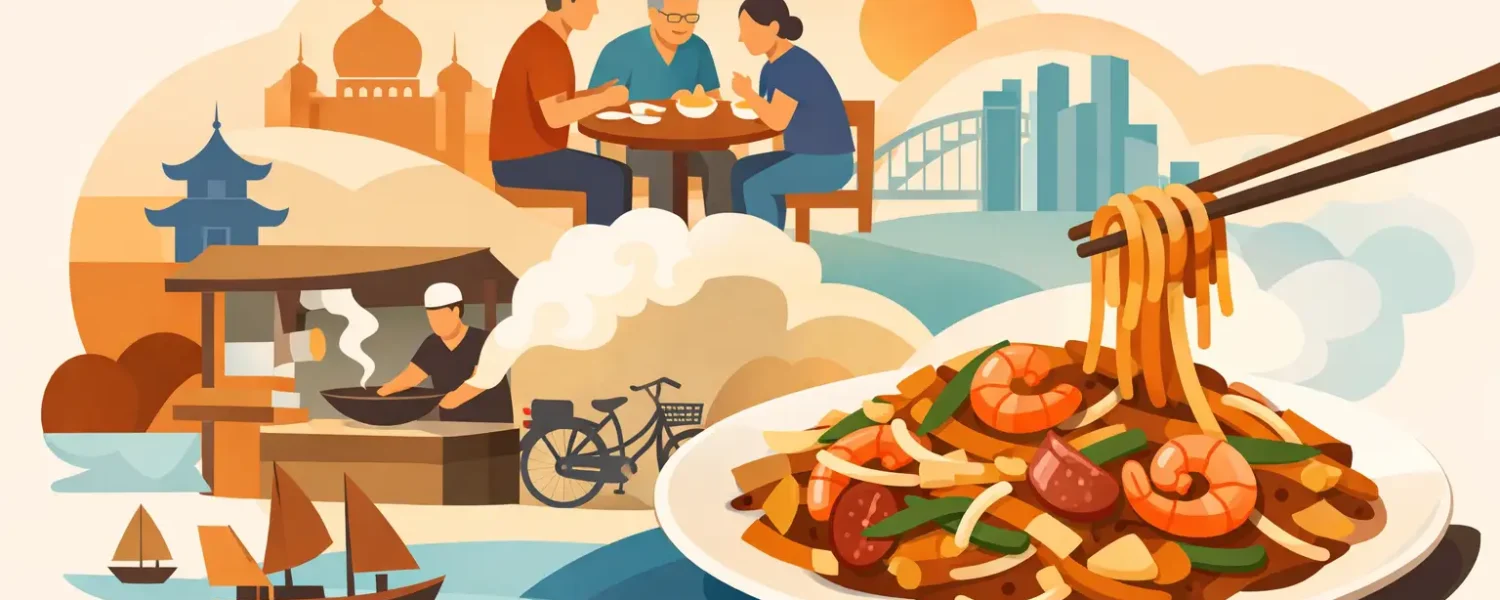
One plate arrives glossy with dark soy sauce, kissed by wok hei, tangled with flat rice noodles, Chinese sausage, bean sprouts, egg, and cockles or shrimp. The char kway teow cultural story begins right there – not as a fancy restaurant tale, but as a working person’s meal shaped by migration, grit, adaptation, and the hawker spirit that still defines how many people experience Singapore.
Char kway teow is often introduced as a “must-try” dish, but that sells it short. If you only taste the sweetness, smoke, and savory depth, you get pleasure. If you know how the dish came to be, you get something richer: a window into the communities that built everyday food culture from the ground up.
Why the char kway teow cultural story matters
This dish carries the history of movement across seas and settlements. Its roots are commonly traced to southern Chinese communities, especially Teochew and Hokkien migrants, who brought cooking methods, ingredients, and noodle traditions into port cities across Southeast Asia. Once these traditions met local markets, local tastes, and local realities, char kway teow became more than an imported noodle dish. It became a lived, regional food shaped by place.
That distinction matters. Hawker food is often discussed like a static treasure chest of old recipes, but it was never static. It changed because people had to make do, sell affordably, and feed different communities. Char kway teow reflects exactly that kind of practical creativity. It is not precious food. It is smart food.
In many versions of its history, char kway teow was associated with laborers who needed a cheap, filling, high-energy meal. Lard gave richness. Noodles gave bulk. Egg and seafood added protein when available. Strong seasoning made simple ingredients satisfying. This was not cuisine built for white tablecloth approval. It was built to keep people going.
From migrant cooking to hawker icon
To understand the char kway teow cultural story, it helps to see hawker food as part of a bigger social map. Migrants did not arrive with a complete menu labeled “national cuisine.” They brought fragments – family habits, dialect-group preferences, preservation methods, stir-fry techniques, and an instinct for adaptation.
Char kway teow sits in that world of exchange. The name itself points to its origins: stir-fried rice cake strips. Yet what ended up on the plate evolved according to what was sold in markets, what customers could afford, and what local palates came to love. In one stall, cockles became essential. In another, lap cheong added sweetness. Some versions leaned wetter and saucier, others drier and more aggressively smoky.
That is part of the beauty of hawker culture. Authenticity here is not about one rigid formula. It is about continuity of method, memory, and street-level meaning. A dish can vary and still remain deeply true to its roots.
Smoke, speed, and the theater of the wok
There is also a performance built into char kway teow. Anyone standing near a skilled hawker knows the signs: the flash of flame, the sharp scrape of metal against wok, the short bursts of tossing, the aroma that hits before the plate lands. This is one reason the dish stays memorable for visitors and locals alike. It appeals to the senses before you even take a bite.
But the show is not just for effect. The high heat matters. Wok hei, often described as a smoky breath or charred fragrance from intense stir-frying, gives char kway teow much of its character. Without that heat control, the dish can turn flat, greasy, or overly sweet. With it, the noodles stay springy, the egg clings properly, and the seasoning becomes layered rather than heavy.
This is where hawker heritage becomes more than nostalgia. Skill lives in repetition. A veteran char kway teow vendor is not simply following a recipe. They are reading moisture, timing, flame, and portion size in seconds. That kind of knowledge is hard earned, and it deserves the same respect people often reserve for more formal culinary traditions.
The char kway teow cultural story is also about class
Not every beloved dish begins with prestige. Char kway teow has long been tied to ordinary life – workers, street stalls, affordable eating, and no-frills satisfaction. That history is central to its identity.
For travelers, this can be easy to miss. A plate of char kway teow today may feel iconic, even celebrated. But hawker food earned that recognition through generations of people who cooked under difficult conditions, served long queues, and created joy out of modest ingredients. The dish is delicious, yes, but it also reflects resilience. It tells a story about how communities fed themselves when elegance was not the point.
That is one reason hawker food in Singapore resonates so strongly with people looking for more than sightseeing. It is not heritage locked behind glass. It is heritage still frying in front of you.
A dish shaped by multicultural appetite
Although char kway teow is closely linked to Chinese migrant communities, its place in local food culture grew through broader multicultural demand. Hawker centers brought different communities into shared eating spaces, where dishes crossed lines of dialect, class, and eventually nationality. What started in one community became part of a common food language.
That is a very Singaporean pattern. Food here often becomes a meeting point before it becomes an identity debate. People may argue fiercely about which stall is better, whether cockles should be included, or how sweet the sauce should be. But the argument itself is part of belonging. When a dish becomes something everyone has an opinion on, it has already entered collective memory.
There is also a useful tension in char kway teow’s evolution. As health awareness grew, some cooks reduced lard or adjusted seasoning. As tourism grew, some versions became more polished or easier for newcomers to approach. These changes make the dish more accessible, but sometimes at the cost of the intense richness older fans remember. That trade-off is real. Preserving a dish does not always mean freezing it in one era, but changing it too much can blur the very character people came for.
What visitors often miss when they eat it fast
Visitors sometimes approach char kway teow like a checklist item: try it, photograph it, move on. Fair enough – there is a lot to eat. But this is one dish that rewards a slower read.
Look at how compact the plate is. Char kway teow does not rely on expensive ingredients or ornate presentation. Its impact comes from balance and heat. Smell the slight bitterness of char against the sweet-savory sauce. Notice how bean sprouts cut through the richness. See how each ingredient has a job to do.
Then think about what that balance represents. This is hawker food at its best – economical, sensory, communal, and shaped by real lives. It tells you something about trade routes, Chinese migration, urban street commerce, and the culture of eating shoulder to shoulder in public spaces. It also tells you why hawker centers matter. They are not just convenient places to eat. They are living archives.
For culturally curious travelers and even locals reconnecting with familiar dishes, this is where food becomes memory work. A plate of noodles can carry labor history, family tradition, dialect roots, and neighborhood pride all at once. That is why experiences that pair tasting with storytelling can change how people remember a meal. At J.I.A.K 99, that is the joy of hawker heritage – you do not just eat the dish, you meet the human story behind it.
More than a favorite noodle dish
The char kway teow cultural story is not neat, and that makes it more honest. It is a story of migrant adaptation, street entrepreneurship, working-class hunger, skilled technique, and shared local identity. It is also a reminder that some of the most meaningful foods are not the most glamorous ones.
So if a plate of char kway teow finds its way to your table, give it more than one quick bite and a photo. Let the smoke, richness, and history settle in together. Some dishes fill you up. This one tells you how a place learned to feed itself, and why that still matters every time people gather to jiak.